

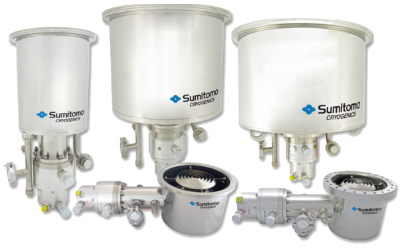

Marathon Cryopumps
What Is a Cryopump?
A cryopump is a high-vacuum pump that captures gas by freezing and trapping it on surfaces cooled to cryogenic temperatures, on the order of 10 to 20 Kelvin. Instead of moving gas out of a chamber the way a mechanical pump does, a cryopump holds gas molecules on its cold arrays, which lets it reach very low base pressures and high pumping speeds for water, air, argon, and hydrogen. Cryopumps are used in semiconductor processing, thin film coating, flat panel, optics, and R&D vacuum systems. Marathon® cryopumps are a line of cryogenic pumps built by Sumitomo Corporation of America, available from 8 inches to 20 inches and driven by SynSysCo OMNI® Helium Compressors.
How a Cryopump Works With a Helium Compressor
A cryopump needs a helium compressor to run. The compressor supplies high-purity, pressurized helium to the pump’s cold head, which expands the gas to reach cryogenic temperatures, then returns the low-pressure helium to the compressor in a closed loop. Those cold temperatures are what let the pump’s arrays trap gas and hold vacuum, so without a working compressor a cryopump cannot cool down or maintain pumping. SynSysCo’s OMNI® Helium Compressors drive Marathon® cryopumps and can run cryopumps from more than one manufacturer on the same tool at the same time. A cryopump also needs periodic regeneration, a controlled warm-up that releases the trapped gas so the pump can return to full capacity.
Cryopump vs. Cryogenic Pump
“Cryopump” and “cryogenic pump” refer to the same type of pump. “Cryogenic pump” is the full technical term and “cryopump” is the common shorthand. Both describe a vacuum pump that traps gas on cryogenically cooled surfaces. You may also see “cryogenic vacuum pump,” which means the same thing.
When to Repair, Rebuild, or Replace a Cryopump
A cryopump usually signals a problem before it fails. Common signs include longer cooldown times, higher base pressure, shorter times between regenerations, reduced pumping speed, or a pump that will not hold vacuum. Many of these issues can be corrected with service or a full rebuild rather than replacement. SynSysCo rebuilds and services Sumitomo Marathon® cryopumps and other legacy cryogenic pumps through its Cryogenic Services group. When a pump reaches end of life, an OMNI® based system lets you replace or upgrade one cryopump at a time instead of changing out a full multi-pump set at once.
A Marathon® Keeps You Running Longer… and OMNI® Helium Compressors Run Marathon® Pumps!
- Made in the USA:
- Marathon® cryopumps are manufactured by Sumitomo Corporation of America in Allentown, Pennsylvania, USA.
- Whisper™ Quiet Technology:
- Provides quiet, low vibration operation combined with world–class performance and reliability. Global OEMs and End Users choose Marathon® for the most demanding semiconductor, coating, flat panel and R&D applications.
- World-Class Performance:
- Industry-leading carrying capacities and extended regen times provide very flat pumping speed curves to maintain chamber performance and pressures.
- Versatile Application:
- OMNI® Helium Compressors drive Marathon® cryopumps which are available from 8 inches to 20 inches and with standard or auto-regen capabilities.
- Global Support:
- Service, maintenance, parts and support are available through seven global locations.
Marathon® Cryopump Models and Specifications
Frequently Asked Questions
What is a cryopump?
A cryopump is a high-vacuum pump that captures and holds gas on surfaces cooled to cryogenic temperatures. It traps gas molecules on its cold arrays instead of exhausting them, which lets it reach very low base pressures for water, air, argon, and hydrogen. Cryopumps are common in semiconductor, coating, optics, and R&D vacuum systems.
How does a cryopump work?
A cryopump uses a two-stage cold head to chill internal arrays to cryogenic temperatures. Gas molecules that reach those cold surfaces condense or are adsorbed and stay trapped, creating and maintaining high vacuum. As the arrays fill, the pump is regenerated with a warm-up cycle that releases the trapped gas so it can return to full capacity.
What is the difference between a cryopump and a cryogenic pump?
There is no difference. “Cryogenic pump” is the full technical term and “cryopump” is the shorthand. Both describe a vacuum pump that traps gas on cryogenically cooled surfaces.
How does a cryopump work with a helium compressor?
The helium compressor supplies high-purity, pressurized helium to the cryopump’s cold head and recovers the return gas in a closed loop. That helium flow is what lets the cold head reach cryogenic temperatures and hold vacuum. SynSysCo’s OMNI® Helium Compressors drive Marathon® cryopumps and can run pumps from multiple manufacturers on the same tool.
When should a cryopump be repaired, rebuilt, or replaced?
Consider service when you see longer cooldown times, higher base pressure, shorter times between regenerations, reduced pumping speed, or a pump that will not hold vacuum. Many pumps can be rebuilt rather than replaced. SynSysCo evaluates the pump and application and handles repair or rebuild through its Cryogenic Services group. When a pump reaches end of life, an OMNI® based system lets you replace one cryopump at a time.
Who rebuilds Sumitomo Marathon® cryopumps?
SynSysCo rebuilds and services Sumitomo Marathon® cryopumps, along with other legacy cryogenic pumps, through its Cryogenic Services group, with support available across multiple global locations.
What applications use cryopumps?
Cryopumps are used where a clean, high-vacuum environment is required, including semiconductor processing, thin film and PVD coating, flat panel, optics, high-energy physics, space simulation, and R&D vacuum systems.
What helium compressor does a Marathon® cryopump need?
Marathon® cryopumps are driven by SynSysCo OMNI® Helium Compressors. The right compressor depends on how many pumps you run and their size, along with your power and cooling setup. SynSysCo can match a compressor to your pump load.
What sizes do Marathon® cryopumps come in?
Marathon® cryopumps are available from 8 inches to 20 inches, in standard and auto-regen configurations. The current models are CP-8, CP-8LP, CP-250LP, CP-12, CP-16, and CP-20. See each model page for full specifications.
What causes cryopump performance problems?
Common causes include an array that is saturated and due for regeneration, contamination inside the pump, cold head wear, a spent adsorber, or a problem in the helium supply or compressor. If regeneration does not restore performance, the pump usually needs service or a rebuild.
For pricing and answers to your questions,
please call our Sales Department at 866-DRY-PUMP (866-379-7867)