

By SynSysCo Engineering. Reviewed July 2026.
Short answer: Whether to repair or replace a vacuum pump depends on more than cost. Repair is usually the better choice when the pump’s core design still fits the process and the fault is a standard service item such as a bearing, seal, or contamination issue. Replacement is the better choice when failures recur, parts are obsolete, contamination risk is rising, or downtime costs more than the pump. In throughput-sensitive work like semiconductor and coating, decide on total cost of ownership and operational risk, not purchase price.
In a semiconductor fab, a coating line, or a cryogenic research system, the vacuum pump shapes what the process can do. When it degrades, throughput, contamination control, and process stability go with it, and the cost lands well beyond the pump.
When performance drops, the question is whether to repair, rebuild, upgrade, or replace the pump. It looks financial, but it also drives uptime, process repeatability, contamination exposure, maintenance planning, and spare parts logistics.
Running a pump to failure is the old approach. Reliability practice now plans around condition, contamination history, and total cost of ownership. In semiconductor and thin-film coating, even a short interruption is expensive, because bringing a chamber back means venting, evacuation, conditioning, calibration, and process validation before production resumes.
What Causes a Vacuum Pump to Fail?
A vacuum pump fails from four things working together: mechanical wear, contamination, thermal cycling, and the gases it handles. These wear the bearings, seals, rotors, and internal surfaces. As they degrade, pumping speed drops, the pump runs hotter, and the instability spreads into the rest of the system.
In oil-sealed systems, degradation may be accelerated by hydrocarbon contamination and particulate circulation. Oil oxidation, condensable vapor accumulation, and chemical byproducts can progressively reduce lubrication quality while simultaneously increasing contamination risk throughout the vacuum system. According to O’Hanlon (2003), contamination within backing stages may ultimately influence the performance stability of higher-vacuum systems including turbomolecular pumps, cryogenic pumps, and ion pumping stages.
Coating systems and semiconductor environments introduce additional challenges because process vapors, fine particulates, and repeated thermal cycling can accumulate within roughing systems over time. Moisture loading and condensable process gases may increase internal corrosion risk and accelerate mechanical degradation. In research and cryogenic facilities, regeneration cycles and repeated venting events can create substantial thermal stress on internal components, increasing long-term maintenance exposure.
Age is the wrong test. What matters is the pump’s condition, how often it fails, what it has handled, and what the process needs next.
When Should You Repair a Vacuum Pump?
Repair the pump when its core design still fits the process and the problem is a standard service item. That covers bearing and seal replacement, contamination cleaning, shaft restoration, cooling repair, and scheduled rebuilds.
In many industrial environments, repair provides significant economic advantages because it extends equipment life while minimizing immediate capital expenditure. Facilities operating standardized pump platforms across multiple production lines may particularly benefit from repair-oriented maintenance strategies because shared spare parts inventories and technician familiarity reduce operational complexity.
Repair also becomes attractive when downtime can be integrated into planned maintenance windows. Coordinated shutdown scheduling allows facilities to restore pump performance while minimizing operational disruption. For high-value production systems, the ability to maintain process continuity during planned service events can significantly reduce overall lifecycle cost.
However, successful repair strategies require more than replacing worn components. Engineers must evaluate whether the restored system will continue meeting throughput, cleanliness, and reliability requirements after repair. A technically successful rebuild may still prove operationally inadequate if the underlying technology no longer aligns with current process demands.
When Should You Replace a Vacuum Pump?
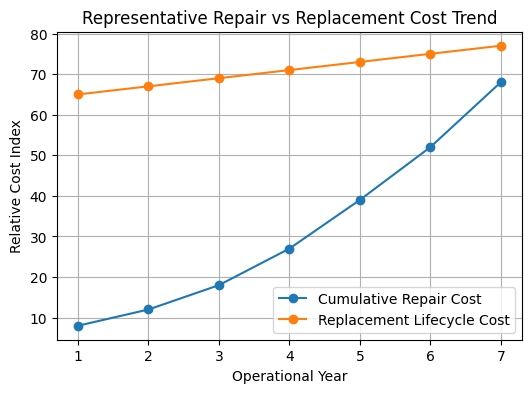
Replacement is often justified when vacuum systems exhibit recurring failure modes, declining efficiency, obsolete component availability, increasing contamination exposure, or escalating downtime frequency. In semiconductor fabrication and vacuum coating operations, downtime costs frequently exceed equipment acquisition costs over the operational life of the system. Consequently, engineers increasingly evaluate replacement decisions according to operational risk rather than purchase price alone.
Older oil-sealed pumps may not meet current contamination, environmental, or energy standards. Moving to an oil-free vacuum architecture usually cuts contamination-related maintenance and cleans up the process.
Base the call on where the process is going, not only the pump’s current state: future throughput, modernization plans, and growth.
Oil-Free vs. Conventional Pumps: The Lifecycle Trend
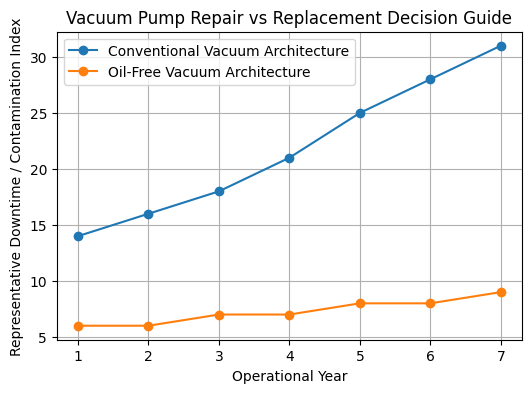
Figure 2 shows a representative trend for conventional versus oil-free architectures. The numbers vary by application, but the direction holds: less contamination and simpler maintenance improve lifecycle reliability.
Should You Switch to an Oil-Free Vacuum Pump?
Oil-free technology shifts the lifecycle math because it removes contamination pathways instead of managing them. In coating, analytical, semiconductor, and cryogenic work, cleanliness is a primary requirement, not a maintenance afterthought.
Hydrocarbon contamination originating from oil-sealed systems can negatively affect coating adhesion, thin-film morphology, detector sensitivity, optical performance, and cryogenic system stability. As process tolerances become increasingly stringent, engineers are therefore placing greater emphasis on vacuum cleanliness and long-term operational consistency.
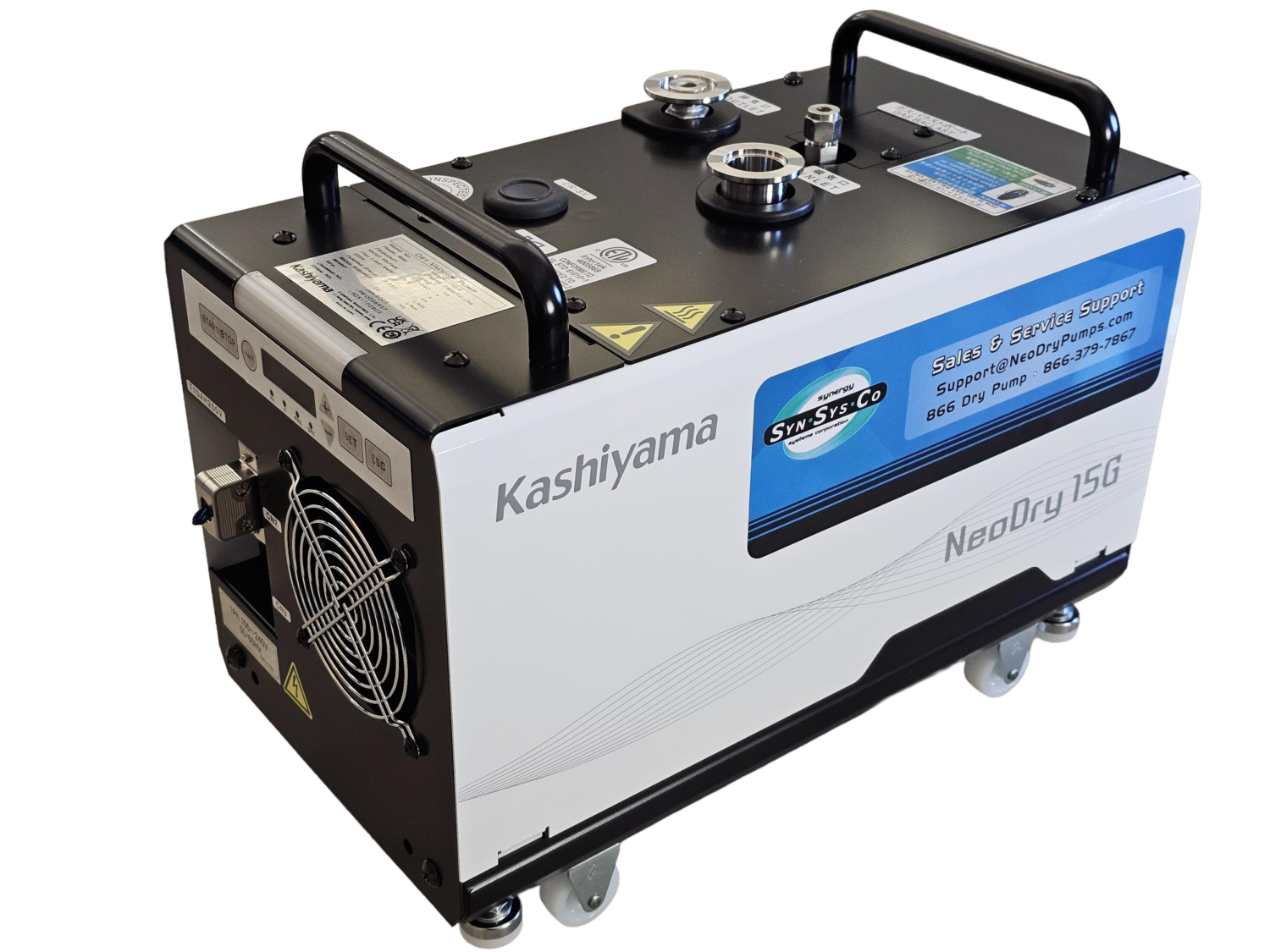
Kashiyama NeoDry G-Series systems provide oil-free operation while supporting throughput requirements extending beyond many conventional laboratory-class dry vacuum technologies. Importantly, NeoDry systems are not dry scroll pumps themselves, although they are frequently evaluated as replacements for dry scroll vacuum technologies in industrial and research applications.
From a lifecycle perspective, oil-free systems may reduce maintenance complexity, eliminate oil disposal requirements, reduce contamination-related downtime, and improve long-term uptime. These operational benefits frequently become more important than initial acquisition cost over the full operational life of the equipment.
Repair or Replace by Application: Semiconductor, Coating, Research, and Industrial
In semiconductor and analytical environments, repair-versus-replacement decisions are frequently driven by contamination risk and process stability rather than purely mechanical condition. Even relatively minor contamination events may justify replacement if the operational risk to process yield becomes unacceptable.
In coating systems, uptime and throughput often dominate engineering decision-making because repeated downtime events directly reduce productive capacity. Facilities operating high-cycle coating systems frequently evaluate replacement opportunities according to evacuation performance, contamination reduction, and maintenance interval improvement.
Research laboratories and national laboratory environments introduce additional considerations including operational continuity, cryogenic compatibility, moisture handling, and long-term serviceability. In these facilities, reliability and repeatability frequently outweigh short-term capital considerations because interruptions may delay experiments, reduce beam availability, or compromise sensitive research operations.
Industrial manufacturing environments often prioritize maintainability, serviceability, and standardization across multiple production lines. Engineers in these environments frequently evaluate replacement opportunities according to energy efficiency, technician familiarity, spare parts availability, and maintenance planning simplicity.
Total Cost of Ownership: The Real Repair-or-Replace Math
Judge the decision on total cost of ownership, not purchase price. Downtime, maintenance labor, contamination recovery, utilities, spares, process interruption, and operational risk all feed the number.
For example, a vacuum coating system experiencing repeated unplanned downtime may incur significant hidden costs associated with lost production, operator idle time, chamber conditioning, and process recalibration. Similarly, research facilities may experience indirect cost through delayed experimentation, reduced equipment availability, and disrupted project scheduling.
Predictive maintenance helps here. Condition monitoring, maintenance trending, and thermal and vibration analysis turn the repair-or-replace call into a data decision instead of a guess.
For maintenance and operations leaders, uptime and a stable process over time matter more than the lowest repair invoice.
How to Make the Repair-or-Replace Decision
The decision to repair or replace a vacuum pump requires a system-level engineering evaluation rather than a purely reactive maintenance response. Engineers must consider contamination control, reliability, lifecycle economics, process criticality, and operational uptime together when evaluating long-term vacuum strategy.
As processes push for more throughput and tighter cleanliness, lifecycle planning only matters more.
The practical path is usually incremental. SynSysCo can rebuild what you already run, and where replacement is the better call, oil-free options like the Kashiyama NeoDry G-Series phase in without a full changeout at once. If you are weighing a repair against a replacement, talk with a SynSysCo engineer about your pump, your process, and your uptime targets.
References
- Mattox, D. M. (2010). Handbook of physical vapor deposition processing. Elsevier.
- O’Hanlon, J. F. (2003). A user’s guide to vacuum technology. Wiley.
- U.S. Department of Energy reliability and maintenance publications.
- Society of Vacuum Coaters technical resources.
- Kashiyama Industries NeoDry G-Series documentation.
Vacuum Pump Repair or Replace – Frequently Asked Questions
Repair when the pump’s design still fits your process and the fault is a standard wear item such as a bearing, seal, or contamination issue. Replace when failures repeat, parts are obsolete, contamination risk is climbing, or downtime costs more than a new pump. Decide on total cost of ownership and operational risk, not purchase price.
Check how often it fails, its contamination history, whether parts are still available, and whether the technology still meets your throughput and cleanliness needs. A pump that rebuilds cleanly and returns to spec is worth repairing. One that keeps failing or can no longer meet the process is a replacement candidate.
Repair has the lower upfront cost, but repeated repairs and unplanned downtime can pass the cost of replacement over the pump’s life. In high-throughput work, downtime often costs more than the pump, so lifecycle cost can favor replacement earlier than the purchase price suggests.
Longer pump-down times, higher operating temperature, rising base pressure, more noise or vibration, and more frequent unplanned stops. These point to wear or contamination, and how far they have progressed decides between service and replacement.
When hydrocarbon contamination is affecting coating adhesion, thin-film quality, detector sensitivity, or cryogenic stability, or when contamination-related maintenance is driving downtime. Oil-free platforms like the Kashiyama NeoDry G-Series reduce contamination pathways and simplify service. The right fit depends on your process gases and vacuum requirements.
Not on an oil-sealed pump. Repair restores worn parts but leaves the hydrocarbon backstreaming pathway in place. If contamination is affecting your process, an oil-free architecture matters more than restoring the existing pump.
Recovery from a vacuum failure usually means venting, evacuation, conditioning, calibration, and process validation before production resumes. Those hidden costs can outweigh the pump itself, so downtime frequency and recovery time should weigh heavily in the call.
Yes. Many cryopumps and helium compressors can be rebuilt to extend service life. SynSysCo rebuilds and supports a range of legacy cryogenic equipment, so a rebuild is often a practical alternative to full replacement.
It covers downtime, maintenance labor, contamination recovery, utilities, spares, process interruption, and operational risk, on top of purchase price. Running the full number usually gives a more accurate repair or replace answer than equipment cost alone.
Yes. SynSysCo handles vacuum pump repair, rebuild, and replacement, along with helium compressors, cryogenic pumps, and cryopump service. Send your pump model, symptoms, and process details and SynSysCo can advise on the better path.