

For decades, the 8200 helium compressor has been a widely used workhorse for cryogenic pumps in semiconductor, thin-film, R&D, and industrial vacuum environments. Historically, the 8200 series delivered stable long-term performance with predictable lifecycles, and SynSysCo has been pleased to service all models of the 8200 since 2017. However, recently, End Users and OEMs have been reporting a sharp rise in premature failures, often occurring years earlier than expected.
OMNI® Replacements for 3-Phase and Single-Phase, Air- and Water-Cooled 8200s

What End Users, OEMs, and Labs Are Communicating to Us
Across multiple markets and applications, several consistent trends have emerged:
A sharp increase in premature compressor shutdowns
Units that historically lasted 10-15+ years are failing far earlier, as soon as 3-5 years.
Rising frequency of thermal faults
Many failures begin as intermittent high temperature shutdowns before progressing to complete shutdown.
Noticeably louder operation
End Users report rattling, vibration, and tonal changes indicating internal degradation.
Repeated trips after cool-down periods
Compressors will restart, run briefly, then fault again due to high temperature signals or high amperage draw, all indicators of internal component failure typically of the heat exchanger or the helium compression module.
Failures often present with no external warning signs
Units may appear clean, leak-free, and electrically stable but still be internally compromised.
These events are occurring across the installed base of aging CTI 8200 populations (15-20+ years) in the field, as well as units manufactured in the 2020-2023 time range.
Most Common CTI 8200 Failure Symptoms
Below is a consolidated set of symptoms reported by technicians and facility managers. Early identification can prevent secondary cryopump damage.
| Symptom | What It Indicates |
|---|---|
| Frequent thermal trips | Motor or internal cooling degradation |
| Low discharge pressure | Degrading helium circuit, internal wear |
| Excessive vibration or noise | Failing bearings or mechanical imbalance |
| Oil contamination | Adsorber exhaustion |
| Inconsistent cold head performance | Insufficient helium flow or oil contamination |
| On/off cycling under load | Impending failure of major internal components |
A persistent combination of these symptoms typically signals end-of-life.
Why CTI 8200 Compressors Are Failing More Frequently
SynSysCo avoids speculation and focuses only on validated, repeatable causes observed through field diagnostics, teardown analysis, and historical performance data. The failures occurring today stem from several overlapping factors:
End-of-Life Across the Population
The majority of 8200 compressors still in service from early to mid-2000 install dates are operating well beyond their original expected lifecycle. Key subsystems, including cooling circuits, bearings, electrical components and internal seals, naturally degrade over time. As materials age, failure rates accelerate.
Component Wear in Aging Helium Circuits
Internal wear and lack of maintenance such as adsorber changes leads to:
- Reduced compression efficiency
- Helium flow instability
- Pressure fluctuations
- Higher operating temperatures
- Higher amperage draw
- Oil contamination of the helium supply line
Even minor losses in helium purity or circulation can compound rapidly once internal tolerances deteriorate.
Thermal Stress and Repeated Overheat Conditions
Operators report thermal trips as one of the earliest signs of failure. When cooling efficiency drops, internal components operate above designed temperatures, accelerating breakdown.
Environmental and Duty-Cycle Shifts
High-duty applications, especially around semiconductor, space simulation, and industrial PVD/etch, place greater load on compressors that accelerate wear due to continuous heavy throughput.
Difficulties in Sourcing High-quality Legacy Replacement Parts
As OEM support and legacy part availability change, maintaining 8200 compressors becomes more difficult. Lower-quality aftermarket parts contribute to unreliable performance and shortened service life.
Operational Risks of Running a Failing 8200 Compressor
Continuing to operate a compromised compressor can lead to significant downstream consequences:
Cryopump Damage
Insufficient helium flow or unstable discharge pressure can overheat or stall cryopumps, leading to:
- Reduced base pressure
- Poor cooldown times
- Permanent internal damage
- Cryopump repairs or replacement can be expensive and negatively impact product throughput
Increased System Downtime
Unscheduled compressor failure often halts the entire vacuum system, impacting production output, product quality and/or delaying experiments.
Contaminated Helium Circuits
If oil separator systems degrade, contaminants can reach the cold head, causing damage that is difficult and very costly to reverse.
Risk of Complete Unit Failure Without Warning
Many 8200 failures escalate quickly. Once thermal cycling starts, full failure is often imminent.
Rising Maintenance and Operating Costs
Aging compressors require:
- More frequent adsorber changes
- Pressure adjustments
- Additional helium handling
Over time, this cost approaches and exceeds the value of maintaining the compressor, especially when considering collateral costs such as tool down time, Technician time, and production quality.
The Most Reliable 8200 Replacement Options
Because the 8200 series is aging out across multiple industries, the most sustainable long-term solution is replacement. SynSysCo supports two excellent replacement-upgrade pathways:
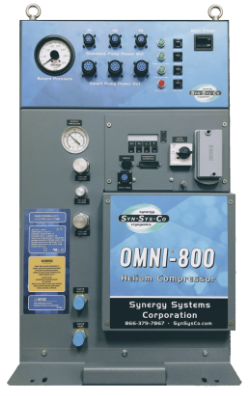
OMNI-800 Helium Compressor
Qty 1-2 8-inch, or 1 10-inch pump
A Direct, Proven 8200 Replacement!
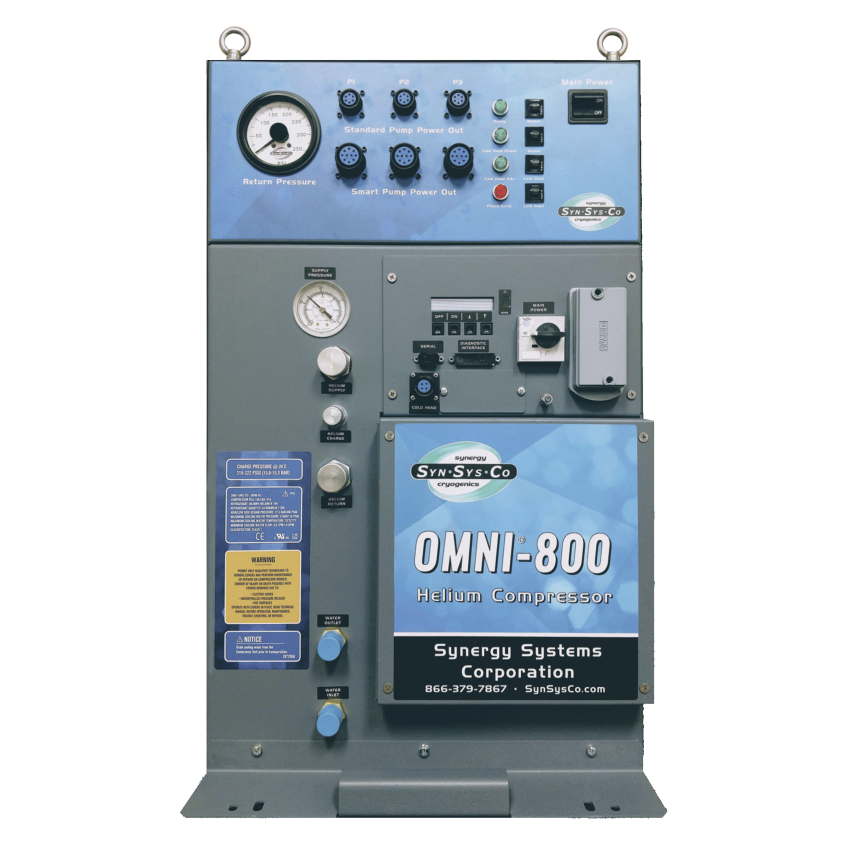
The OMNI-800 is an air or water-cooled, 3-Phase, 208 VAC unit engineered to support legacy and modern cryogenic pumping requirements while delivering greater reliability than aging units. It addresses the core issues associated with 8200 failures, including cooling performance, serviceability, and operating cost. It replaces the 8200 3-phase water-cooled and/or air-cooled units. It operates Cryo-Torr® and On-Board® Cryopumps and water pumps, in addition to Trillium CryoPlex®, Sumitomo Marathon®, and CRYO H&I GENCryo® pumps.
Best for:
- R&D Labs, PVD, Accelerators, high energy physics (Reference our OMNI-900 for even higher performance)
- Small to medium OEM equipment
- Facility upgrade of multiple legacy 8200 compressors, or upgrading entire cryogenic platforms
Key Advantages:
- Plug and Play replacement using existing utility and control hookups
- Higher cooling capacity
- Enhanced Helium displacement
- Improved long-term reliability
- More efficient system-level integration capabilities
View the OMNI-800 Compressor with links to its manual and our OMNI catalog:
OMNI-100 Helium Compressor
For 1 8-inch pump
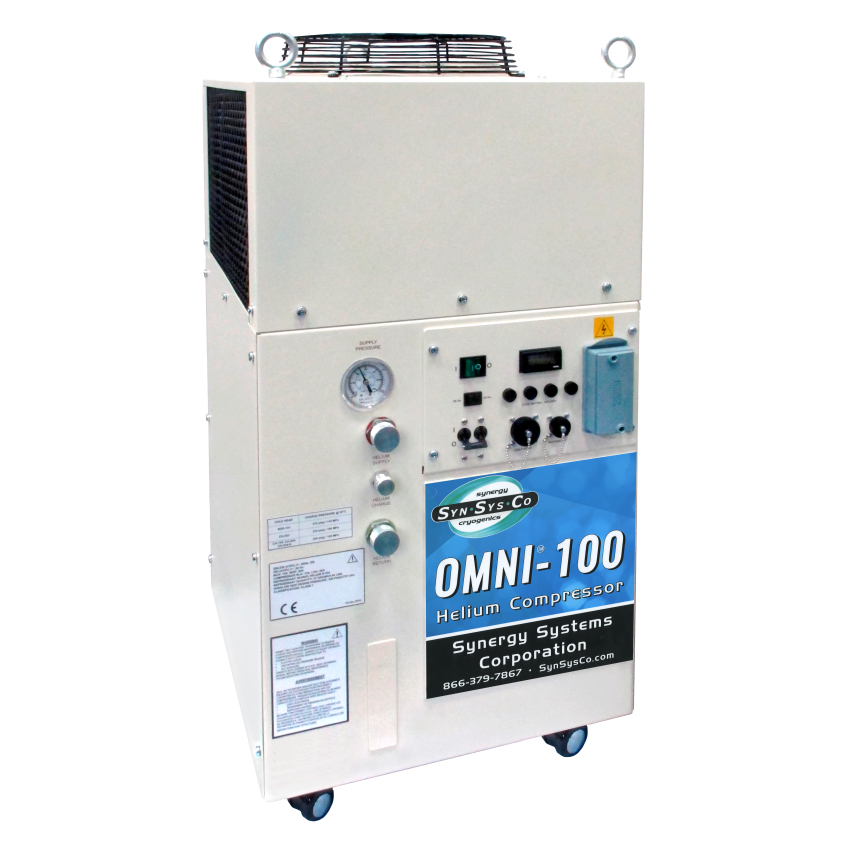
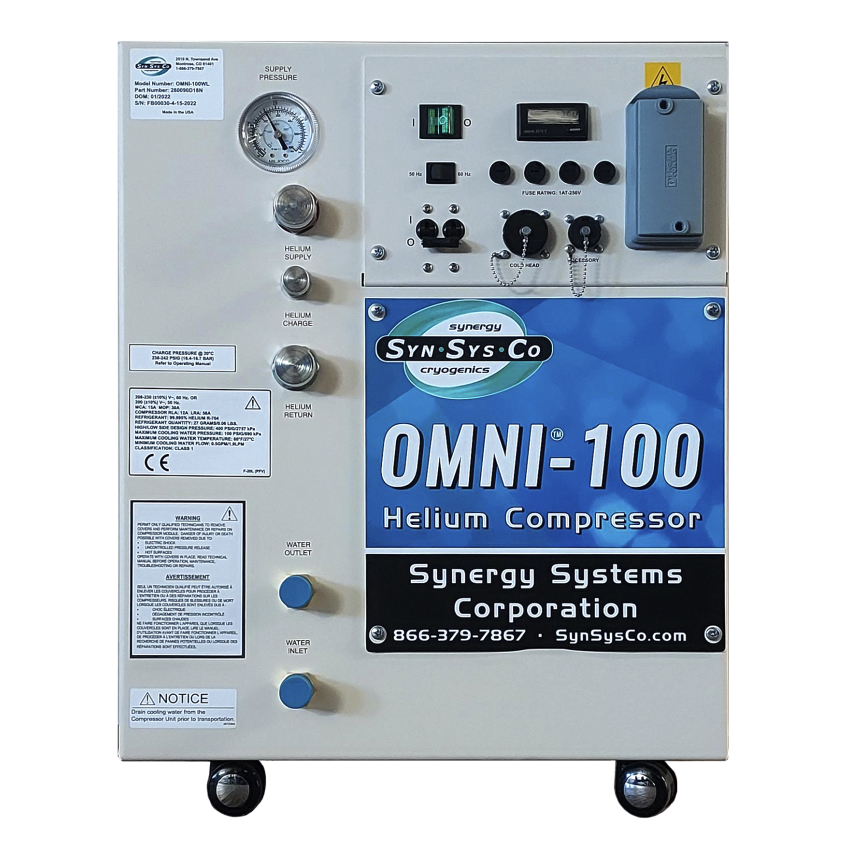
The OMNI-100 is a single-phase, 208 VAC, water- or air-cooled unit recommended when facilities need more headroom and better thermal performance. It replaces the 8200 water-cooled or air-cooled single-phase compressors. (It also replaces the no longer manufactured CTI SH air- and water-cooled compressors.)
Ideal for:
- Lab/Research applications
- Vacuum systems requiring stable, continuous cooling
- Customers seeking a long-term replacement for legacy single phase 8200 and SH compressors.
Key Advantages:
- Plug and Play replacement using existing utility and control hookups
- Stable helium pressures under high duty cycles
- Modern component materials improve thermal performance
- Designed for compatibility with legacy cryopump systems
- Lower lifetime maintenance burden
View the OMNI-100 Compressor with links to its manual and our OMNI catalog:
Cost Considerations: Repair vs. Replace
Below is a simplified lifecycle comparison showing why replacement is increasingly the value-added choice.
| Option | Initial Cost | Long-Term Cost | Reliability | Supportability |
|---|---|---|---|---|
| Repairing 8200 | Low to medium | High (frequent service) | Declining | Limited |
| OMNI-800 Replacement | Medium-high | Low | Long Term | Full support |
| OMNI-100 Replacement | Medium | Low | Long Term | Full support |
Summary: If an 8200 has begun thermal cycling, running noisy, or showing discharge instability, replacement with an OMNI-800 or OMNI-100 typically results in lower lifetime cost compared to ongoing 8200 repairs and associated freight costs and downtime costs.
When to Replace a CTI 8200 Compressor Immediately
A compressor should be taken offline to prevent cryogenic pump and/or product damage and replaced if any of the following occur:
- Repeated thermal trips after servicing
- Low discharge pressure that does not respond to adjustment
- Continuous vibration or abnormal noise
- Rising temperature despite adequate cooling
- Three or more unexplained shutdowns in a 30-day period
- Oil contamination of the helium supply line
If you’re unsure, the SynSysCo technicians can evaluate system conditions and recommend a replacement plan. Or call 1-866-DRY-PUMP.
A Strategic Path Forward
As the 8200 legacy platform ages out, users face higher maintenance costs, unexpected downtime, product loss, and risks to cryopump health.
The most reliable long-term solution is upgrading to a modern replacement: OMNI-100 for direct replacement needs and OMNI-800 for direct replacement and higher-capacity or modernization initiatives.
SynSysCo’s engineers can help diagnose your failing unit and recommend the best upgrade path based on your application, duty cycle, and budget.
Speak with a SynSysCo Technician
For technical guidance or a replacement recommendation, contact SynSysCo’s expert team today at Info@SynSysCo.com or call 1-866-DRY-PUMP.